
LA GAIA MADRE - Group exhibition 1-17 May
The exhibition
La Gaia Madre (Mother Gaia) — Sotterranea Nuova, Castello di Vigevano · 1–17 May. A group exhibition of visual and performative art organized by the Evuz Art collective and curated by Fortunato D'Amico.
The show places the relationship between humanity and the planet at its centre, beginning from a critical view of contemporary environmentalism. The Earth is evoked as a generative mother and, at the same time, as a wounded one — an exploited body, a surface reduced to commodity — until it reveals its other face: that of an "Unhappy Mother," exposed to predatory economies and to the rhetoric that masks the plunder of the living.
The gaze is interdisciplinary. Mother Earth is told in her archetypal dimension, but also within networks of material processes, biological cycles, infrastructures, geopolitical conflicts and extractive economies. Art takes on a civic and cognitive role: works, performances and documentary materials make the emergencies of the present perceptible, and reawaken awareness of the planet and those who inhabit it. Three narrative axes run through the show — Earth as living body, Earth as space of communities, and Earth as symbolic and relational matrix — while the staging unfolds as a kind of secular cathedral,
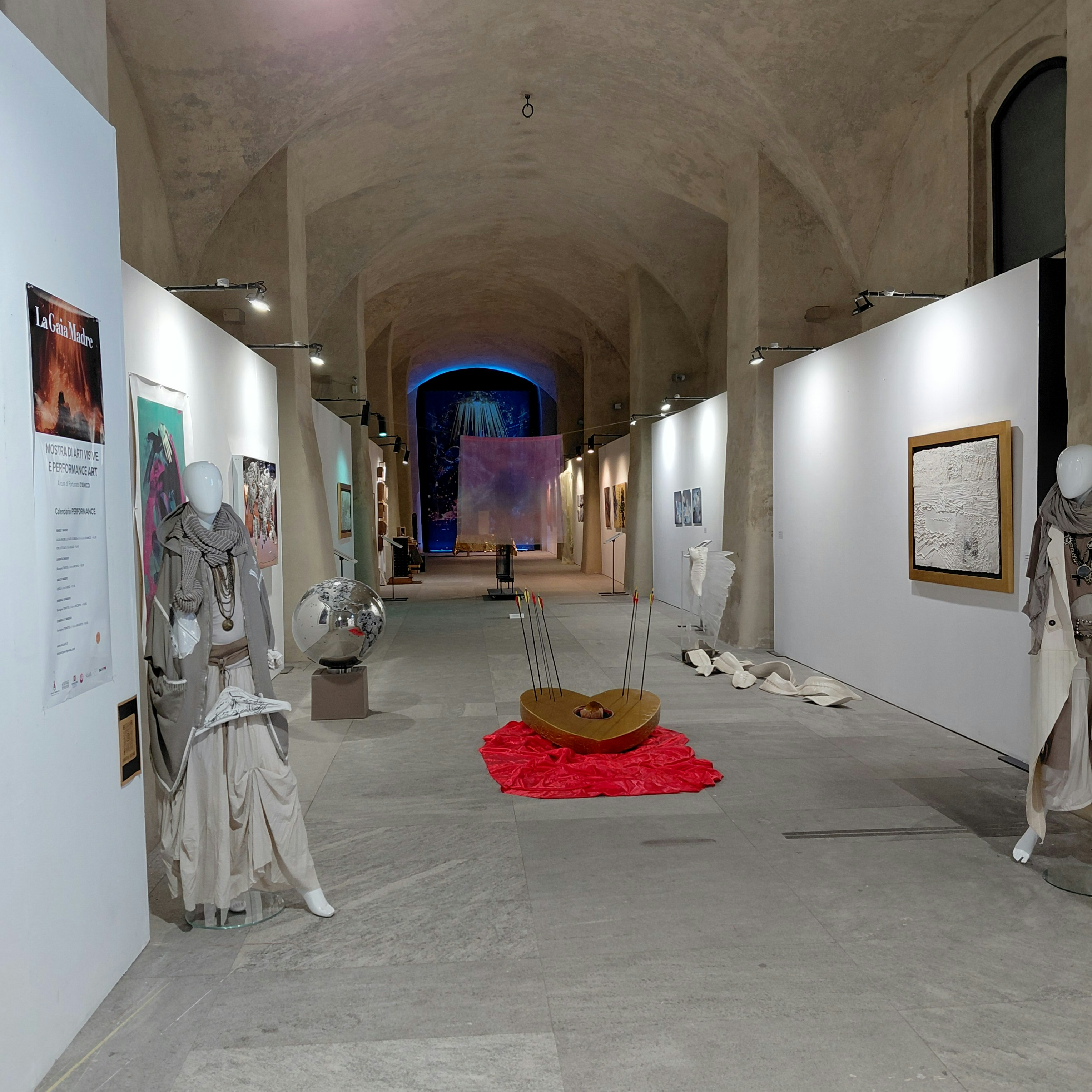
moving from the materiality of the Earth toward its symbolic, ritual and cosmological dimensions.
The work — a triptych of interior landscapes
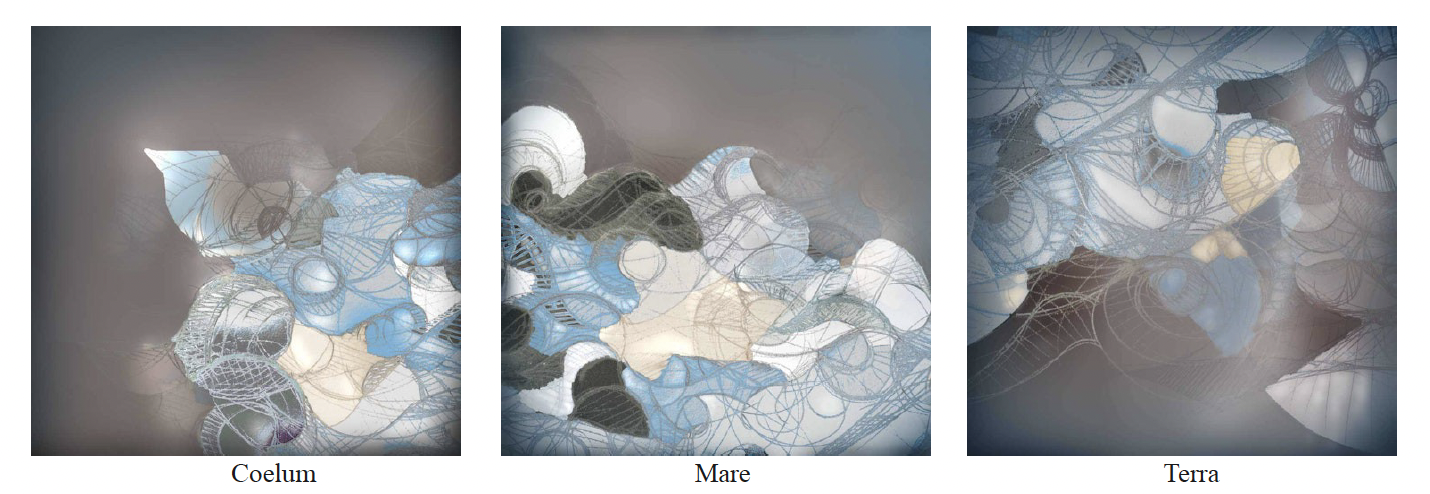
For La Gaia Madre I presented three works from my Mindscapes series: a triptych titled Coelum, Mare, Terra, fine-art prints on wood panel (minimum 50×50 cm), produced through Digital Stain Immersion.
Mindscapes is born from the exploration of interior landscapes, where perception becomes image and thought takes visual form. Sky, sea and earth are not natural elements described from the outside: they emerge as mental states — perceptual dimensions through which the mind relates to the world. They are not separate entities but interconnected dimensions of a single living system, one in which the human being is already involved, held in an unstable equilibrium and a constant becoming. Here the landscape becomes mental and cosmic at once — a silent continuity between the inner world and the wider processes of nature and the universe.
- Coelum — the sky as a dimension of the mind: openness and distance, the aerial breath of thought.
- Mare — the sea as a dimension of the mind: depth and flux, the moving ground of feeling.
- Terra — the earth as a dimension of the mind: weight and rootedness, the body's belonging to matter.
(nota: queste tre righe sono una mia glossa evocativa; se hai un'intenzione precisa per ciascun pannello, dimmela e la sostituisco)
In dialogue with La Gaia Madre
La Gaia Madre names a pathology of the present: a theatrical ecology of exposed bodies and repeated declarations, performative identities that seek recognition more than change — a false environmentalism built on separation, between those who claim to protect and what is protected, between the human and the Earth as distinct entities set in conflict.
Mindscapes proposes something more radical: that separation is an illusion. We do not need to return to nature, because we never left it. Sky, sea and earth are not outside us — they are within, already inscribed in the structure of perception, already present in the unconscious gesture before the mind recognizes and names them.
This is what the process demonstrates without declaring it. When the hand traces a sketch without intention — not as an artistic act, but as a perceptual note in the everyday interaction with the world — what emerges already carries the form of the elements. Not by thematic choice, but by the structure of experience.
Seen this way, the ecological question is, first of all, a question of perception: the inability to feel nature as part of ourselves. These works do not stage the conflict between human and nature, nor dramatize the tension between poles; they emerge from a process in which that separation does not yet exist. They inhabit the relation from within — not testimony, not militancy, but the revelation of a continuity that never truly ceased, and that must be recovered. It is for this reason that the triptych belongs to the exhibition's symbolic and relational axis: to confront these works is an invitation to recognize something already always happening in the observer — the process by which sensation becomes thought, and thought becomes a way of being in the world, inseparable from the ecosystem we are part of.
Process and technique
The starting point is always the automatic sketch: marks traced without premeditation, born in the daily interaction with the world — not conscious artistic acts but perceptual notes in real time, closer to a stream of consciousness, experience as a continuum of intensities and half-formed impressions.
From these sketches a layered transformation begins. Through Digital Stain Immersion — a technique I developed, immersing the scanned drawing in chromatic fields through selective adjustments of brightness, contrast and saturation — the image is extended into the digital domain, preserving the texture of the original paper while introducing new structural and perceptual complexity. More recently the same approach has reached beyond fine-art print toward oil, acrylic and mixed media, where the digitally elaborated sketch stays active beneath layers, opacity and material resistance.
The Mindscapes triptych is part of the Visions corpus (theme: The Infinite Horizon). More work at raimondoart.com.
