
Codici Contemporanei - 7-15 Feb 2026
The event
Codici Contemporanei — part of the 8th edition of "Ho visto un genio!", the art event organized by the Astrolabio APS association in Vigevano and curated by Gabriella Maldifassi. Strada Sotterranea Nuova, Castello Sforzesco di Vigevano · 7–15 February 2026, under the patronage of AIAPI (International Association of Plastic Arts – Italy, a UNESCO partner).
The event was born to celebrate Leonardo da Vinci, who in 1494 was in Vigevano, at the Sforzesca, drawing the water stair that channelled the flow toward the Mulino della Scala. This edition takes its cue from Leonardo's pages to focus on the idea of the code — from its original meaning to the present day.
"Codice" comes from the Latin codex — originally the inner wood of a tree trunk, later the waxed writing tablet, and finally the manuscript book. A code is always a system of signs, symbols or rules that carries information to whoever knows how to read it: a means of communication between individuals, machines and environments. Codes are everywhere — from algorithms to social conventions, from cultural symbols to systems of surveillance. Linking Leonardo's codes to contemporary ones sets past and present in dialogue: Leonardo as a kind of Renaissance programmer, treating knowledge as a system to analyse and recombine, working with mirror writing, symbols and mental prototypes much as we now work with software and algorithms. The exhibition asks who writes the codes today, what happens when they are manipulated or subverted, and whether artistic autonomy still survives.
The work — "Il linguaggio della mente"
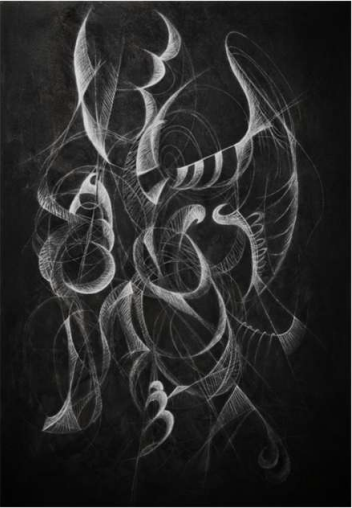
For Codici Contemporanei I presented "Il linguaggio della mente" (The Language of the Mind) — mixed media, acrylic and oil with graphite on canvas, 100 × 70 cm.
The work explores the moment in which a mental sensation takes visual form. It begins from an unconscious sketch that — like the pages of Leonardo — uses the sign not only to represent, but to think. The lines become the traces of an interior language, a silent writing that binds perception and emotion. The work makes thought visible in its making: a code that is born from feeling.
In dialogue with the theme
If a code is a system of signs that carries meaning to whoever can read it, then the automatic gesture is perhaps the first code of all — the mind writing to itself before words arrive. This is the thread that ties the work to Leonardo: in his notebooks the sign is already an instrument for thinking, not only for depicting; the mirror writing, the tangled annotations, the diagrams are thought caught in the act.
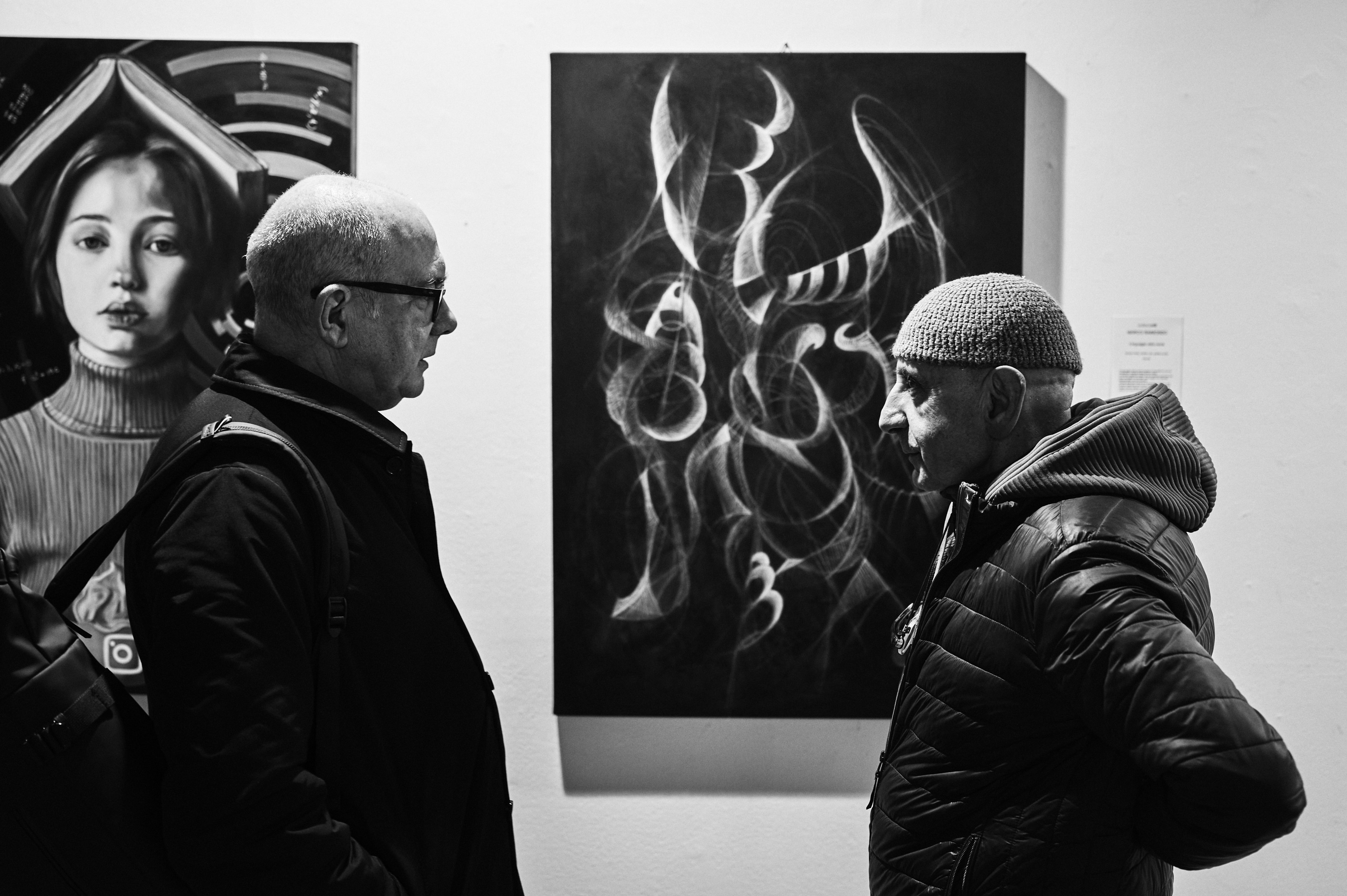
"Il linguaggio della mente" works in the same territory, but turns it inward. The trace is not the encoding of an idea already formed: it is the very moment in which sensation becomes thought. A code, here, is not something imposed on experience from outside — it rises from feeling, from the body's contact with the world, before the mind recognizes and names it. To read this work is less to decipher a message than to watch a code take shape.
Process and technique
The starting point is always the automatic sketch: marks made without premeditation — perceptual notes taken in real time rather than deliberate artistic acts. From there the image enters a layered process. In this work the digital lineage of my Digital Stain Immersion meets the hand again on canvas: acrylic and oil grounds, a graphite line, stratification and material resistance give the interior sign a body — depth, opacity, a tactile presence — so that the "language of the mind" is not only seen but felt as matter.

